Kite-of-the-Old-Wind learned to read the world by its leftovers.
Not footprints, not blood, not the heroic debris of battle. He read the thin, stubborn traces sound leaves behind when it has nowhere else to go. The tremble in a tavern’s windowpanes after a shout. The soft ringing in a sword’s fuller after it’s been drawn too fast. The hush that sticks to a room after someone says a name they promised never to say again.
Sound, to Kite, was a kind of handwriting.
And somewhere in all that handwriting, there was a letter he could never stop chasing.
He called it the First Voice.
Not because it was the first voice anyone ever heard, but because it was the first voice he ever copied that made his bones feel like they were being tuned by invisible fingers. He’d been young then, more hunger than sense, and he’d heard it in a place wind should not have been able to speak.
A stone waymarker on the old road. A sideways mouth carved into it, worn by centuries. The night smelled of wet moss and lightning held back. Kite had crouched beside it, listening for the usual things, distant carts, moth wings, the soft threat of owls, and then the air had inhaled.
The world took one careful breath, like it was about to confess.
A sound came, not loud, not even fully audible, but shaped with terrible precision. It wasn’t a word in any language, and it wasn’t a song either. It was the idea of a word, the original curve a throat makes before language learns to lie or pray or flirt. Kite’s feathers had lifted in alarm, and he had done what kenku do.
He copied it.
Perfectly.
The instant the sound left his beak, the night seemed to recognize him. The grasses leaned as if bowing. The waymarker’s carved mouth looked less like stone and more like a listening wound. The air pressed close, curious, intimate, and Kite felt something settle inside his chest, like a splinter of winter lodged behind his ribs.
Then the wind laughed.
Not kindly. Not cruelly. Just… inevitably. Like weather.
Kite ran, because running was the only answer he’d ever trusted.
He expected the moment to fade the way strange moments do, like smoke losing interest. It didn’t. The First Voice stayed. It didn’t speak to him with sentences. It answered him the way a drum answers a hand, the way a bell answers a rope, the way a storm answers a mountain that dares it.
Whenever Kite sang, the air sang back.
Not in the melody itself, but in the notes between notes.
A thin second harmony that made candles lean toward him. A pressure behind the ears that made strangers rub their necks and frown, as if they’d just remembered something important and couldn’t place it. A faint taste of rain on stone, even indoors.
At first, Kite thought it was power. He thought he’d stumbled on a new kind of trick, and tricks were how the world fed you without asking you to deserve it.
Then he learned what copying costs.
It happened in a tavern whose floorboards were warped from spilled ale and older grudges. A brawl broke out, quick and ugly. A man shouted a name, raw with grief. It wasn’t an insult, it wasn’t a threat. It was a name spoken like a rope thrown across water.
Kite caught it, almost by accident. The sound was bright, and he liked bright things.
He mimicked it a moment later, trying to calm the fight with familiarity, with recognition, with the authority that names carry.
The room went still.
Not because he’d solved anything. Because the air had shifted.
In the quiet that followed his mimicry, the First Voice breathed through him, soft as a blade sliding into its sheath. The tavern’s shadowlight seemed to deepen, and several people blinked as if the world had moved a fraction of an inch to the left.
The man who’d shouted the name opened his mouth again, and nothing came out.
His tongue moved. His throat worked. But the name would not form.
He pressed both hands to his face like he could physically find the missing sound. He made small, panicked noises, animal noises. When he tried again, his voice broke on an empty space, like trying to step onto a stair that wasn’t there.
The brawl dissolved into confusion.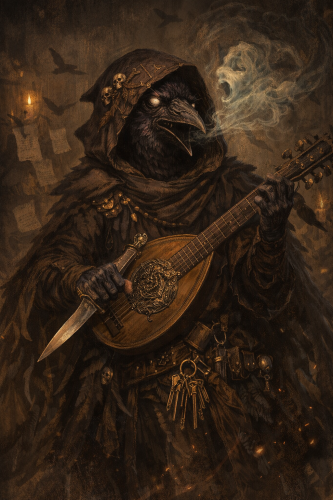
Kite stood frozen with his lute in his hands, and for the first time in his life he understood that some stolen things do not stay stolen.
They get collected.
The First Voice inside him was not a trophy. It was a hook in the world’s fabric.
And it was pulling.
From then on, Kite stopped thinking of himself as a thief of voices. He became something else, something quieter and far more terrified.
A courier for an unfinished sound.
The First Voice didn’t demand worship. It didn’t issue threats like a villain with a monologue. It simply… persisted. It was old and listening, and it kept turning its attention toward places where air felt strange, as if parts of itself were scattered there.
Kite began to notice that his life was acquiring a direction the way rivers do. Not chosen, but inevitable.
And he realized another truth: danger makes people loud, and loud people leave useful echoes.
So he started traveling with adventurers.
Not because he loved the chaos. He hated the chaos. Chaos was unpredictable, and unpredictability was how you died. But adventurers were walking thunderstorms. They shouted oaths. They cried prayers. They screamed warnings. They laughed too hard on nights they should have been sleeping. They told the world they were alive in a thousand loud ways, and the air around them became thick with clues.
Kite stayed close, hood up, eyes bright, listening.
He kept a ledger, not of lies and secrets, but of resonances. Places where the First Voice answered a little too clearly. Moments when the wind did something that felt intentional.
The first clear sign came outside a ruined town where ivy had eaten the walls but left a bell tower standing, stubborn as an accusation. The locals called it the Hungry Chime. They said it rang with no bell on nights when storms were far away. They said if you answered it, you’d lose your favorite sound.
Kite climbed the tower at dusk while the party argued below about whether the ruins were haunted or merely dramatic. The stairs creaked like old knees. Dust clung to his feathers. At the top, the belfry was empty.
No bell.
Yet the rope hung there, taut, eager, as if expecting hands.
Kite reached out and pulled, gently, testing.
The tower rang.
Not loudly. Not even properly. It was a vibration that slid through stone and bone and teeth. A note so pure it made Kite’s eyes water. He felt it more than heard it, and the First Voice inside him surged like a startled animal.
For a heartbeat, the air around Kite seemed to tighten into shape. Not a figure, not a face, but an intention. The wind inside the belfry pressed close, curious, like a cat deciding whether you’re worth loving.
Kite lifted his lute and plucked a single string.
The note hung in the air.
The First Voice answered, threading itself between the vibration of the tower and the trembling of the string. The harmony was so exact it felt like the world had finally clicked into alignment.
Below, a child in the street laughed, bright as a dropped coin.
Then stopped.
Kite looked down in time to see the child’s face crumple in confusion. The laugh had been taken mid-flight, like a bird snatched out of the air. The child tried again and made only a tiny, breathy squeak.
Kite’s claws tightened around the lute until the wood complained.
The wind in the tower did not apologize. It did not gloat. It simply settled, satisfied, as if a payment had been accepted.
Kite wrote in his ledger that night with shaking hands.
The Name collects resonance.
He didn’t sleep. He sat near the campfire and watched the flame lean toward him when he breathed.
One of the adventurers, half-asleep, mumbled, “You okay, bird?”
Kite answered in a voice he’d borrowed years ago from a kindly old innkeeper, soft and warm.
“Fine,” he said.
In the silence after, the First Voice whispered through the gap between his syllables, too quiet for anyone else to notice.
Bring me the rest of me.
Kite didn’t tell the party. Not yet. It wasn’t fear of judgment. It was fear of making it real. If he spoke it aloud, it might become a kind of promise, and promises, he had learned, were loud.
Instead, he followed the pattern.
The next places weren’t marked on any map, not in ink. They were marked in air.
A mountain pass strung with chimes and bone charms that clattered without wind. A desert arch that sang at noon even when the heat was still. A shipwreck cove where the sea itself sounded muffled, as if someone had put a hand over its mouth.
In each place, Kite felt the First Voice tug, not like a leash, but like gravity. Something in the world was calling itself back together, and Kite was caught in the middle like a needle caught in a magnetic field.
The party began to notice the oddities. The way birds went silent when Kite approached. The way a door would unlatch itself only after Kite hummed a note he swore he didn’t know. The way campfire smoke always curled toward him, even in crosswinds.
“You’re cursed,” one of them said one evening, half joking, half not.
Kite didn’t answer with denial. He answered with a sound like a kettle beginning to boil, because it was easier than truth and less dangerous than explanation.
They laughed, uneasy.
Then came the Still-Choir.
They didn’t announce themselves with fanfare. They arrived like a soft closing door.
The first sign was a roadside shrine where every hanging charm had been wrapped in waxed cloth. No clinking, no whispering, no song. Even the grass around the shrine seemed to hush itself, as if silence had weight.
Kite approached and felt his chest tighten. The First Voice inside him pressed against his ribs, annoyed, like a storm trapped in a jar.
A figure stepped from behind the shrine, face hidden behind a mask with no mouth. Another figure followed, then another, all wearing the same smooth silence. They carried bells stuffed with wax, chimes bound tight, instruments gagged.
Their leader lifted a hand in greeting.
She did not speak. She held up a slate and wrote with quick, elegant strokes:
WE DO NOT FEED THE WIND.
Kite stared at the words, and the First Voice behind his ribs growled without sound. The air around him seemed to vibrate with frustration.
The leader wrote again:
YOU CARRY A FRAGMENT. YOU ARE BEING USED.
Kite’s feathers prickled.
The leader tilted her head, almost gentle. She wrote:
LET US REMOVE IT. LET YOU BE QUIET.
The offer, horrifyingly, sounded like mercy.
Kite’s hands shook. He looked back at his companions, their faces tense, uncertain, readying for violence if it came. He could feel the First Voice pushing against his throat like a second set of lungs.
He didn’t want to be used.
He also didn’t want the world to lose another laugh.
He picked up his lute.
He played.
Not a battle song. Not a charm. A single open chord with space inside it, a chord that left room for breath. The sound floated outward, and for a moment the Still-Choir’s silence wavered, like a curtain in a draft.
The leader stiffened. She raised a hand sharply.
The masked figures moved forward, fast, precise.
Kite felt the First Voice surge.
The air thickened. Hair rose with static. Dust lifted off the road and hovered as if uncertain which direction gravity belonged. The party shouted and drew weapons, and their loudness fed the moment like oil feeds flame.
Kite did not want a storm. He wanted an answer.
He planted his feet and played another chord, then another, shaping the space between them. He made a doorway in the air. A corridor wide enough for something ancient to pass through without breaking everything it touched.
The wind answered.
For the first time since that night at the waymarker, Kite heard the First Voice not as a haunting, but as a presence. It threaded itself through his music with aching familiarity, like a hand finding an old scar.
The pressure eased. The dust fell. The Still-Choir hesitated, as if they had felt the edge of something too large to fight.
The leader wrote on her slate, her hand suddenly less steady:
IT WILL NOT STOP.
IT WANTS ITS WHOLE NAME.
Kite played a soft, questioning note.
The leader’s eyes, visible through the mask’s narrow slits, sharpened.
She wrote:
IF IT BECOMES WHOLE, IT WILL SPEAK.
IF IT SPEAKS, IT WILL REMEMBER.
AND WHAT IT REMEMBERS WILL NOT BE KIND TO THOSE WHO BROKE IT.
Kite understood then, not with intellect but with instinct. The wind was not just weather.
It was a witness.
Someone had shattered its True Name to keep it from testifying. To keep it from carrying certain screams, certain confessions, certain last words across borders and into history.
The Still-Choir wanted to keep it broken, not for evil’s sake, but for control’s sake. Silence is a cage that looks like peace from far away.
Kite lowered his lute and took out his ledger. He flipped to the first page and showed the leader the mark he’d copied from the old waymarker, drawn in charcoal: a sideways mouth.
The leader stared at it for a long time.
Then she wrote, slowly:
THE EYE OF THE GALE.
Kite’s heart kicked like a trapped bird.
The leader wrote again:
A STONE RING WHERE WIND TURNS PERFECTLY.
IT IS SAFE THERE.
SAFE ENOUGH TO SPEAK A NAME
WITHOUT BREAKING THE WORLD.
Kite looked up. His companions were watching him now, not with suspicion, but with the weary understanding of people who’ve realized their friend has been carrying a whole separate war inside his ribs.
Kite tapped the ledger with one claw, then pointed down the road.
He didn’t need words.
The road itself seemed to lean forward, eager.
Days later, they reached the place.
It wasn’t a tower or a shrine or a city. It was a natural amphitheater of stone, a ring of standing rocks worn smooth by time and weather, arranged as if the world had built itself an ear. Inside the ring, the air was calm, still as held breath. Outside it, wind tore at grass and cloaks and hair with impatient hands.
Kite stepped into the ring and felt his entire body unclench, as if his bones had been waiting for this shape of silence.
In the center stood a single stone, its surface carved with spirals. At first glance it looked like scratches. When Kite tilted his head, the spirals resolved into something that made his eyes sting.
Not letters.
Not words.
A song pattern. A breath pattern. The rest of the True Name, waiting like a chord you’ve been missing all your life.
Behind him, the Still-Choir appeared at the edge of the stones, masks pale in the stormlight beyond. The leader raised her slate as if it were a shield.
Kite lifted his lute.
He felt the First Voice inside him, suddenly very quiet.
Not gone.
Listening.
As if the wind itself had stepped back to see what he would choose.
His companions formed a loose circle behind him. Nobody spoke. Even the fighter, usually incapable of silence, held it like a fragile cup.
Kite looked at the carved spirals and understood a truth that tasted like salt.
If he completed the Name, the wind would become whole. It would stop borrowing him. It would stop collecting resonance like a debt. It might also remember everything done to it, and memory in something that old can look a lot like vengeance.
If he refused, he would keep the fragment. The wind would keep answering him, forever, a beautiful curse. People would keep losing sounds in his wake.
He ran his claws gently over the lute’s strings.
Then he played.
Not to command the wind. Not to bind it. Not to bargain.
To introduce himself.
He picked a melody made from the voices he’d carried, but he changed it. He adjusted the rhythm. He bent the notes until they fit the shape of his own heartbeat. He didn’t copy. He composed.
The sound rose into the still air of the ring and held there, pure and steady.
The First Voice answered, and this time it did not shove its way through him.
It harmonized.
Soft. Exact. Ancient.
Kite felt it like a hand resting on his shoulder. Not ownership. Not possession. Recognition.
He played the melody again, and on the second pass he let the carved spirals guide him. He let the stone’s breath-pattern slip into the music, not like a master taking control, but like an ocean joining a river.
The wind around the ring shuddered.
Outside, the storm paused.
The Still-Choir’s leader lowered her slate, slowly, as if she had forgotten why she was holding it.
Kite reached the final note and held it, trembling.
In the silence that followed, the world leaned in.
And between his last note and his next breath, the First Voice spoke its True Name, not as a weapon, not as a command, but as a homecoming.
The air inside the stone ring warmed.
Far away, a child laughed, and this time the laugh did not vanish. It carried on the wind, bright and intact, and Kite felt tears he hadn’t asked for slip down his beak’s edges.
The borrowed choir inside him went quiet, not dead, not stolen, just… resting. Like a crowd leaving a theater after the show is done, satisfied and a little changed.
Kite lowered his lute.
For the first time in his life, the silence around him didn’t feel like absence.
It felt like space.
Space for his own voice to grow into.
He turned to his companions, and when he spoke, the sound that came out was not anyone else’s.
It was rough. It was small. It was new.
But it was his.
“Thank you,” Kite said.
And the wind, whole again, moved through the stones like a vast creature stretching after a long sleep, and it did not take anything from anyone.
It simply went on being the witness the world had tried to break.
And Kite, at last, walked forward without the feeling of a storm pressing its mouth against his throat.
Generated by AI
Also available on Substack with an extra image
