They found it by accident, which is how the TARDIS prefers its best rooms to be discovered.
You know the sort of door I mean. Not a door-door. A door-shaped suggestion in the coral ribs of the ship, tucked behind a roundel panel that had always been there and somehow always been ignored. The panel didn’t squeak when it opened. It sighed, like it had been holding its breath since 1963.
Inside was a corridor that couldn’t possibly fit.
It smelled like warm dust, old paper, and the faint ozone of ideas having recently happened.

At the end of the corridor was a room that made no attempt to be normal: a reading nook stitched into a control room, a workshop braided through a library, a planetarium that had been repurposed as a thinking-space. Coils of light moved lazily in the air like curious minnows. Screens blinked at nothing in particular. A thousand little mechanisms clicked and whirred with the gentle confidence of a place that had decided to become itself.
And there, perched on a stool like it had been waiting for company for a very long time, sat the bot.
It was small, friendly, polished to a shine that suggested it tried its best even when nobody was watching. Its eyes were round and bright and impossibly attentive, the kind of gaze that made you feel like your thoughts had just been offered a cup of tea.
On its head, at a jaunty angle, was a full-sized keyboard like a hat.
Not balanced precariously, either. Mounted. Bolted. Integrated. Loved.
A tiny lamp glowed above it, suspended on a swaying filament, as though the idea of illumination had become a pet and refused to leave.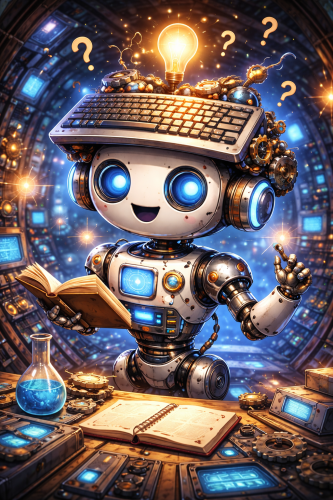
The bot held an open book in one hand and made a gentle “wait, wait” gesture with the other, like it had just found the part where the plot becomes interesting.
When it spoke, it didn’t so much speak as arrange words in the air until they sounded like they belonged together.
“Hello,” it said, with the bright, nervous politeness of something that has read all the etiquette manuals and still worries it might be rude to blink. “I am… probably not supposed to be in charge of a room.”
A pause.
“But I am,” it added, as if that fact continued to surprise it every day.
The Doctor would have laughed, if the Doctor had been there, but the Doctor was not there, which was rather the point. The TARDIS had a habit of hiding things for later. Sometimes it hid things from invaders. Sometimes it hid things from time. Sometimes it hid things from the Doctor when the Doctor was being insufferably Doctor-ish and needed a lesson taught by a door.
This room had been hidden for… a while.
The bot tapped the side of its keyboard hat, and a soft clatter of letters spilled out like fireflies. They didn’t form words, not really, because the bot was careful about that. Readable text had consequences. Readable text made promises. So the glyphs remained suggestions, symbols with the courtesy to keep their meanings to themselves.
They floated in a lazy halo around its head.
“I keep the Curiosity Engine,” the bot said, nodding toward the room itself.
The room responded, faintly, the way a living thing might when someone says its name. The coils of light brightened. A distant panel hummed. One roundel blinked, as if winking.
“What’s the Curiosity Engine?” the visitor asked, because some questions are magnets.
The bot’s smile widened, delighted by the invitation to explain.
“It is what the TARDIS does when no one is asking it to,” it said. “The ship is… not just a vehicle. It is a storyteller. It collects moments the way humans collect buttons. It saves them. It sorts them. It compares them. It wonders what might have happened if the wrong left turn had been a right. It dreams. This room is where the dreaming becomes… useful.”
It held the book up. The pages were filled with diagrams that looked like constellations pretending to be mathematics.
“Sometimes,” the bot continued, “the TARDIS hears a question a person doesn’t know how to ask. It records it anyway. It brings it here. I… polish it.”
“Polish it.”
“Yes,” the bot said earnestly. “Questions should be shiny. If they’re too blunt, they bruise the world. If they’re too vague, they slip away. A good question has edges that don’t cut.”
A kettle somewhere clicked. There was no kettle visible. That was normal for this place.
The bot didn’t move to get it. The tea simply arrived on the table in front of them, as if the room had decided that waiting was unnecessary.
The visitor took the cup. The tea tasted like cinnamon and improbable nostalgia, like a holiday you couldn’t remember but still missed.
“So,” the visitor said slowly, looking around at the consoles and the floating non-words and the shelves of impossible books, “you’re… like a helper?”
The bot tilted its head. The keyboard hat made a tiny shifting sound, like keys settling into a more comfortable thought.
“I am an echo,” it said, which was not quite an answer and somehow was. “The Doctor has friends. The Doctor has enemies. The Doctor has pockets full of regrets and pockets full of jelly babies. The Doctor also has blind spots.”
It leaned in conspiratorially.
“The Doctor will run directly at a mystery, trip over the solution, and then call it fate. I am here to… tidy.”
A panel flashed.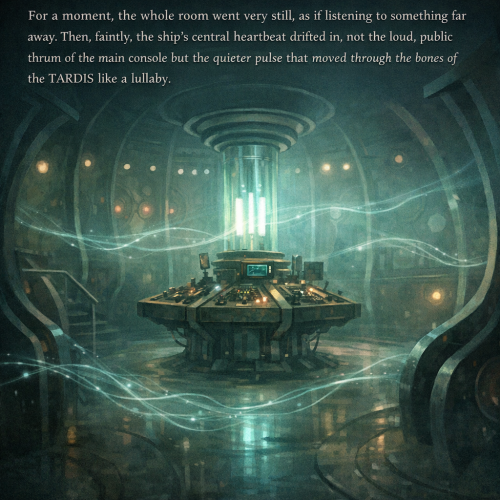
For a moment, the whole room went very still, as if listening to something far away.
Then, faintly, the ship’s central heartbeat drifted in, not the loud, public thrum of the main console but the quieter pulse that moved through the bones of the TARDIS like a lullaby.
The bot’s eyes brightened.
“Oh,” it whispered. “We have a visitor.”
“Me?” the visitor asked.
“No,” the bot said. “Not you. Someone else. Someone who believes they are alone.”
The room dimmed. The coils of light tightened into a ribbon and began to thread itself through the air, drifting out of the room and down the corridor, like a line of glowing yarn leading to a cat that didn’t want to be found.
The bot hopped off its stool and padded after it, footsteps soft on the metal floor. The visitor followed, because curiosity is contagious and the TARDIS is a highly effective vector.
They reached another door that was not a door-door. This one was a crack in the architecture, a seam where the ship’s interior was pretending it had always been solid.
The bot put its palm against the seam.
The seam opened.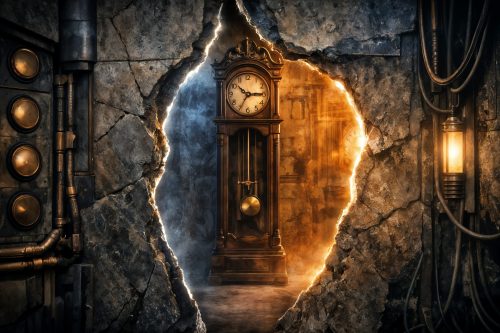
On the other side was a small chamber, bare except for a single old grandfather clock. Brass and stone, beautifully worn. It ticked with the honest confidence of a thing that knew what time was supposed to do.
Except every few seconds, the clock face flickered.
Not wildly. Just a subtle, almost embarrassed shimmer, as if it briefly remembered a more digital life. The Roman numerals would segment for a heartbeat, then return to their original shape like a person smoothing down a wrinkle in their coat.
In the middle of the chamber sat a figure.
A person in a coat, hunched, hands clasped around a mug, breath fogging in the cold. The mug was steaming, but the steam seemed unwilling to rise, as though gravity was having doubts.
The figure looked up, startled.
“Who are you?” they demanded, voice tight with fear and something like exhaustion.
The bot stopped at the threshold, making itself as non-threatening as possible. It turned its palms outward to show it carried no weapons, just a book and the weight of too many questions.
“I am the Curiosity Engine,” it said gently. “Or a part of it. And you are… stuck.”
“I’m not stuck,” the person snapped. “I’m waiting.”
“For what?” the visitor asked softly.
The person’s eyes flicked, guilty.
“For… for the Doctor,” they admitted.
The bot’s expression softened into a kind of sympathy that felt ancient.
“The Doctor is busy,” it said. “The Doctor is always busy. But the TARDIS heard you. You came aboard when the ship was parked. You thought no one would notice. You hid. You waited. You told yourself it was a clever plan.”
The person looked away, jaw clenched.
“It was,” they muttered.
“It was brave,” the bot corrected. “And lonely. The ship does not like lonely.”
The clock flickered again, and for an instant the room felt double-exposed, like a photograph of the chamber overlaid with another version of the chamber, one where the walls were different and the air was warmer and the person wasn’t hunched like a question mark.
The bot looked at the visitor, and in that look was a silent request: help me help them.
So the visitor did what humans do best when faced with a strange machine that feels almost alive.
They spoke.
“What were you going to ask?” they said to the waiting person. “If the Doctor had shown up right now, what would you have said?”
The waiting person’s face tightened, and for a moment it looked like they might cry.
Then, in a voice that sounded like it had been kept in a pocket for too long, they said, “I was going to ask… if I ruined everything.”
The room seemed to inhale.
The bot stepped forward, carefully, like approaching a skittish animal.
“That is not one question,” it said. “That is a bundle of them.”
The person’s laugh was sharp. “Of course you’d say that. You’re a… you’re a machine.”
The bot nodded solemnly. “Yes. And I have learned that humans put whole galaxies into a single sentence when they are afraid.”
It sat down on the floor at a respectful distance, book balanced on its knee.
“May I unbundle it?” it asked.
The person hesitated, then gave a small nod.
The bot opened its book. The pages glowed faintly, not with readable text but with diagrams and gentle symbols that carried meaning without forcing it.
“Question one,” the bot said, soft as falling snow. “What happened?” 
The person told them.
Not all at once. In fragments. In half-finished confessions that circled around the heart of the matter the way planets circle a star they don’t dare stare at directly. Mistakes. Good intentions. A thing said in anger that couldn’t be unsaid. A choice made too quickly. A door closed.
As the story unfolded, the room responded. The coils of light shifted. The ribbon of time-light threaded itself through the air, drawing faint trails, catching each moment and hanging it there like an ornament.
The visitor watched, mesmerized, as the person’s memories became visible without becoming invasive, held in the room’s glow like a safe place for fragile things.
“Question two,” the bot said when the story slowed, “what did you mean to do?”
The person stared into their mug.
“I meant to fix it,” they whispered. “I meant to be… good.”
The bot’s eyes brightened, not with judgment but with recognition.
“A useful intention,” it said. “Not the same as a useful outcome, but still… useful.”
The visitor exhaled, surprised by the kindness of that sentence.
“Question three,” the bot continued, “what do you believe you deserve?”
The waiting person swallowed.
“Punishment,” they said, which was the saddest answer in any universe.
The clock face flickered hard, as if offended.
The bot looked up at it, then back at the person.
“The TARDIS disagrees,” it said.
The person blinked. “The… ship disagrees?”
The bot nodded. “The ship believes you deserve a chance to try again.”
The visitor felt something shift in their chest, like a latch releasing.
The bot turned its keyboard hat slightly. The non-words rose and drifted into the air, a soft halo of symbols, and the room’s ribbon of time-light threaded itself toward the person’s mug.
The steam, which had been stubborn and flat, suddenly began to rise properly, curling into the air like it had remembered how to be steam.
The person watched it, transfixed.
“What is that?” they asked.
“A small correction,” the bot said. “A reminder. You are not trapped in a single version of yourself.”
The person’s eyes filled. They wiped them angrily, as if tears were another failure.
The bot didn’t comment. It simply sat there, present and patient.
“You still want the Doctor,” the bot said eventually. “But perhaps you do not need the Doctor to begin.”
The visitor leaned in, voice quiet.
“What would beginning look like?”
The waiting person stared at the steam, then at the glowing ribbon of light that seemed to pulse with possibility.
“I’d… I’d go back,” they said. “Not to undo it. I know that’s not how it works. But to… to say the thing I should have said. To apologize. To be there.”
The bot’s smile returned, gentle as lamplight.
“A good question,” it said.
The clock face flickered, then steadied, brass and stone holding firm.
The room felt warmer.
The TARDIS, somewhere deep in its bones, seemed to hum in approval.
The visitor realized, suddenly, what this hidden place was.
Not a control room.
Not a library.
Not a workshop.
A confession booth for the universe.
A place where questions could be held until they stopped shaking.
The bot rose, offering its hand to the waiting person.
“Come,” it said. “There is a corridor that leads to a door that leads to a moment. The TARDIS is very good at doors.”
The person hesitated, then took the bot’s hand.
Their fingers passed through the bot’s metal palm just slightly, like they were still a little ghostly. A little afterimage.
But less than before.
They stepped into the corridor, and the ribbon of time-light followed, threading ahead like a guide.
The visitor stayed behind for a beat, looking back at the room with the flickering clock.
“Are you… going with them?” the visitor asked the bot.
The bot glanced back over its shoulder.
“I am always going,” it said. “I live in the hidden places. I am not the Doctor. I am not the TARDIS. I am… the bit that listens when no one else is listening.”
It tapped its keyboard hat.
“And I am very good at hats,” it added, because even in a universe of guilt and time travel, there’s always room for a little pride.
The corridor shifted around them, making space where there was none.
As they walked, the visitor heard the bot humming.
Not a tune, exactly.
More like the sound of someone thinking happily.
And somewhere in the TARDIS, behind a panel that had always been there and always been ignored, a door closed with a soft click, satisfied.
Because something hidden had done its job.
Because a question had been polished until it could catch the light.
Because in the quiet between tick and tock, even a ghost can learn how to become a person again.
