Cyran was born in a port-city where promises were cheaper than fish and just as likely to stink by morning. Sailors swore they’d come back. Merchants swore their weights were honest. Lovers swore forever like it was a coin they could spend twice.
His mother kept a tiny shop between a bookbinder and a lampwright, the kind of place that smelled like beeswax and paper dust. Officially, she sold stationery and sealing wax. Unofficially, people came to her when they needed to make a vow that stuck. She’d press a crescent stamp into warm wax and murmur a few careful words, and the promise would settle into the world like a nail into wood.
Cyran grew up watching promises become real. He learned early that truth has weight. He also learned that broken oaths don’t vanish. They linger. They gather in corners. They rot into resentment. They turn into the kind of bad luck that follows a family for generations.
The night everything changed was a storm-night, the city’s favorite kind, the sky throwing knives and the sea throwing them back. Cyran was fifteen, minding the shop, when a man arrived dripping seawater and righteousness. He wanted an oath sealed fast, something binding, something cruelly simple.
“I swear,” he said, “to deliver my daughter to the Sisters of the Gilded Veil by dawn. In exchange, I will be rich enough to never beg again.”
Cyran’s mother refused. Her hands didn’t shake, but her eyes went cold. Some promises were cages, and she would not be the lock.
The man begged. Then threatened. Then, when her back turned, he stole the crescent stamp and smashed a finger of wax onto the counter himself, pressing the seal down hard enough to crack the wood.
The vow took.
Cyran felt it, not with ears or skin, but with something inside his skull that flinched like a struck bell. The shop lights dimmed. The air tasted metallic. Outside, the storm paused for half a breath, listening.
His mother snatched the wax and tried to break it, but a sealed promise doesn’t snap like twine. It unthreads you. The crescent seal burned into her palm like a brand, and she went white, as if the moon had pulled all the color out of her in one greedy tug.
That’s when Cyran learned the oldest law of binding magic: if you witness a vow being forged, the vow witnesses you back.
Before dawn, the man died in an “accident” at the docks. The Sisters never arrived. The girl vanished anyway.
And Cyran’s mother began to fade.
Not dying, not ill, just… thinning. Like a story being erased line by line. She could speak in the mornings, but by evening her voice would slip away. One week she forgot Cyran’s name. The next, she forgot her own face. A month later, she was a silhouette behind fogged glass, and then she was gone entirely, as if the world had decided it had never needed her.
In the empty shop, Cyran found the stolen crescent stamp wrapped in a cloth, still warm, still hungry.
He should have thrown it into the sea. Instead, he pressed it to his wrist.
The crescent mark appeared at once, pale and permanent, and he felt something open in his mind like a door to a dark room.
That night, when he dreamed, the moon spoke to him.
Not a voice, exactly. More like a pressure behind the eyes, a silent insistence. A ledger unrolling in his thoughts, names and vows and debts written in ink that shimmered like frost. He saw promises as threads, bright when kept, blackened when broken. He saw broken oaths gathered like stormclouds around certain people, heavy enough to drown a soul.
And he saw one vow burning like a brand across the ledger:
Deliver the daughter to the Sisters of the Gilded Veil by dawn.
The vow hadn’t been fulfilled. It hadn’t been properly broken. It had simply… been redirected, like a river forced into new ground.
Cyran understood then that a vow doesn’t care about “fair.” A vow cares about completion.
So he went hunting.
He found the Sisters not in a gilded convent, but in a traveling theatre that performed “miracles” on moonless nights. Their velvet curtains smelled of incense and greed. Their audience left lighter in coin and heavier in obligation.
The girl, now called Maris, had been remade into an acolyte-actress with a painted smile and eyes like locked doors.
Cyran tried to free her the simple way: with a knife and a map and a plan.
The plan failed immediately.
The Sisters caught him backstage and offered him a bargain so sweet it almost tasted clean:
They would release Maris if Cyran took the vow into himself, becoming its bearer, its anchor, its completion.
He refused. They smiled wider.
“Then you can leave,” they said, “and the vow will finish itself. It always does. It just chooses new routes.”
That night Maris disappeared again, and Cyran woke with ink stains on his fingers and the moon-ledger louder in his skull.
He tried to pray it away. He tried to drink it away. He tried to bury it beneath other work.
Nothing muted it.
Because the mark on his wrist wasn’t a curse.
It was a job offer.
Cyran became what the city feared but occasionally needed: someone who collects what people throw away and pretend never mattered. Not gold. Not jewels. Not even lives.
Promises.
He learned to see vows clinging to people like perfume. He learned to taste lies as a metallic tang in the air. He learned that some communities survive only because one stubborn grandmother has kept the same small vow for forty years.
He also learned that the worst monsters don’t break promises. They keep them in the most devastating way possible.
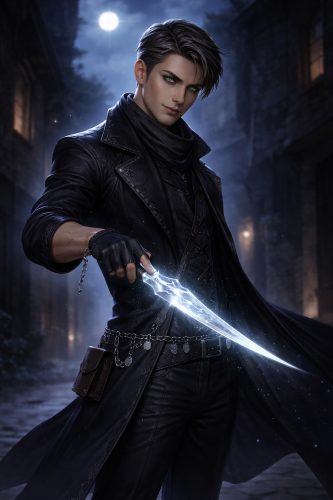 His Soulknife gift arrived the first time he tried to “cut” a vow free.
He confronted a local magistrate whose oath to protect the poor had been twisted into legal cruelty. The man laughed at Cyran’s evidence, laughed at the moon-mark, laughed at the idea that a promise could have teeth.
So Cyran reached into that dark room in his mind, and pulled out a blade made of moon-glass.
It wasn’t steel. It wasn’t even truly light. It was intention sharpened until it could slice what couldn’t be touched.
He didn’t stab the magistrate.
He carved the oath-thread loose from the man’s spirit, and the magistrate collapsed as if someone had removed the spine from his pride. The oath, freed, coiled around Cyran’s wrist like cold smoke, and a new token appeared on the silver chain at his belt: a stamped crescent with a crack through it.
After that, word spread in the hidden ways word spreads: whispers in taverns, chalk marks on alley posts, coded phrases in love letters.
If your brother swore he’d return and never did, if your lover promised forever and left you with ash, if your king vowed protection and handed you to wolves, there was someone who could make the debt… acknowledged.
Not always paid. Not always healed.
But named.
And naming is power.
Cyran’s rules became his armor:
-
He never takes a vow from someone who intends to break it. (He can taste the lie before the ink dries.)
-
He never collects a promise from the innocent. (He’d rather starve than become the Sisters.)
-
He never destroys a vow. He reassigns it, binds it to the one who benefitted from its breaking, or to himself if no other justice exists.
That third rule is why he’s slowly becoming haunted.
Every promise he “holds” sits inside him like a pebble in a shoe. Small pains become constant pains. Constant pains become a limp. A limp becomes a personality. A personality becomes a legend.
And legends don’t sleep well.
Now, his silver chain bracelet carries tokens stamped from reclaimed oaths, each one silent and heavy. Some are simple: “I will write,” “I will return,” “I will forgive.” Others are vicious: “I will obey,” “I will sacrifice,” “I will never speak.”
He is hunting Maris still, because her vow is still unfinished. The ledger insists on it. The moon insists on it. Sometimes he wonders if Maris is alive, if she became one of the Sisters, if she became something worse.
Sometimes, on moonless nights, he suspects the vow is not attached to her anymore at all.
It might be attached to him.
Because the mark on his wrist pulses when he gets close to certain theatres, certain temples, certain smiling people with immaculate teeth. The crescent seal warms like wax near flame.
Cyran walks into towns like a rumor wearing boots. He takes jobs as a courier, a bodyguard, a translator, a gambler, whatever keeps him close to secrets. He listens. He watches. He waits until someone says the words that always open the door:
“I made a promise.
And it’s not letting me go.”
Then he smiles that polite half-smile, as if the ending has already been written.
And he offers a choice.
He can help you keep your promise.
Or he can help you pay for breaking it.
Images and story created by ChatGPT 5.2
Now on Substack
Tokens Under a Borrowed Moon The Tale of Cyran Darkmare, Moon-Loan Collector
